Summary
Roughly 10 to 20 percent of people who are resuscitated after cardiac arrest later report experiences they place in the time they were unconscious: floating above their own body, a light, a review of their own life or a border after which they return. The reports are so similar that researchers have measured them with standardised scales since the early 1980s. Attempts to verify seeing from above have produced no evidence so far: in two large AWARE studies, nobody recognised any of the test images, though with very few cases that could be evaluated. Brain research has candidates for individual building blocks: oxygen deprivation, disturbed processing in specific brain areas, a last flare-up of fast brain waves and a flood of the body's own chemical messengers. Much of this, however, is only supported indirectly. What the brain delivers, culture interprets, and culture even helps decide which building blocks get reported at all.
How often it happens
Cardiac arrest is the state in which medicine comes closest to death and still brings people back. Anyone who is resuscitated has gone seconds to minutes without circulation and without recognisable consciousness. Some of these people later describe experiences that they place in exactly this period. When those experiences actually arise, during the arrest, during resuscitation or while waking up, cannot be determined afterwards.
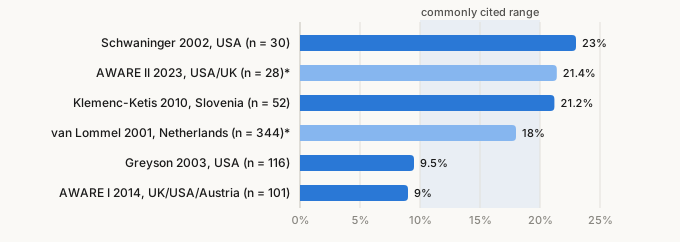
How large that group is depends on where and how you ask. The best-known study comes from the Netherlands: cardiologist Pim van Lommel interviewed 344 patients after cardiac arrest. 62 of them (18 percent) reported a near-death experience, 41 a pronounced one, a so-called core near-death experience. That is 12 percent of everyone interviewed.
Other studies land between 9 and 23 percent. A 2025 review in Nature Reviews Neurology gives a range of 10 to 23 percent. The often-quoted 10 to 20 percent is therefore a useful reference point, not a fixed figure.
Measurement is usually done with the scale published in 1983 by the American psychiatrist Bruce Greyson. It asks about 16 features in four groups: thinking, feelings, apparently paranormal perceptions and the sense of entering another reality. Each feature scores 0 to 2 points, and from 7 out of a possible 32 points an experience counts as a near-death experience. Greyson set the threshold one standard deviation below the average of his comparison group of people with near-death experiences.
A near-death experience is therefore a value on a scale. Someone who reaches 7 points counts as a case in studies, someone who reaches 6 does not.
What people experience
The topic was popularised in 1975 by the American philosopher and later physician Raymond Moody with his book "Life after Life". Since then the same building blocks have been described again and again, though in varying order and rarely all together.
Out-of-body perception. People experience themselves detached from their own body, often floating below the ceiling, looking down at their own resuscitation or at the scene of an accident.
Time and clarity. Many describe thinking that is faster and clearer than in everyday life, and a feeling that time no longer matters.
Tunnel and light. A dark space or tunnel with an intense light at its end that does not dazzle.
Life review. Scenes from one's own life play out very quickly or all at once, often combined with a reassessment of past actions.
Border. A threshold, a barrier or a decision, after which the person returns to the body.
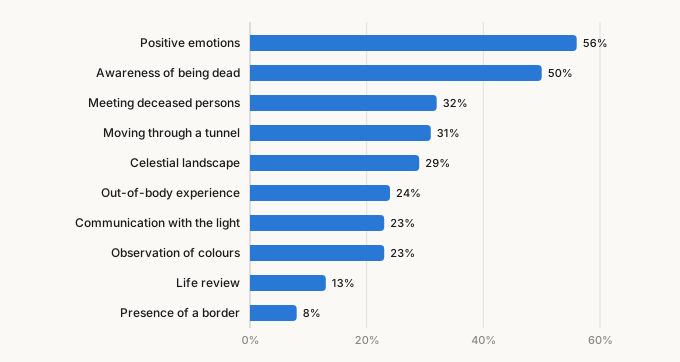
In reality hardly anyone experiences all the building blocks, and how often they occur does not match the cliché. Van Lommel counted them for his 62 patients. The tunnel, the symbol of the near-death experience par excellence, appeared in 31 percent, the life review in 13 percent. The most frequent were positive emotions and the awareness of being dead.
Not every near-death experience is pleasant
The picture of the peaceful light is still incomplete. Some people experience fear, emptiness or threat. In 1992 Greyson and the researcher Nancy Evans Bush distinguished three forms: the typical experience perceived as threatening because one loses control, the feeling of drifting alone in an endless void, and, less often, hellish images.
How often this happens depends heavily on how you look. In van Lommel's hospital study nobody reported a distressing near-death experience. In a collection of 190 accounts at the University of Liège, only 2 were classified as negative in 2014. When the Liège researchers searched 123 submitted accounts specifically for distressing content in 2019, they arrived at 14 percent. In her own compilation, which was not published in a scientific journal, Bush counted 332 distressing experiences among 1,910 near-death experiences in 20 studies, just over 17 percent.
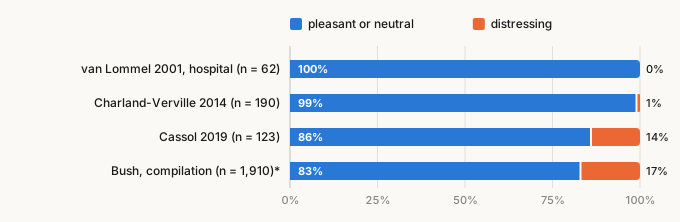
The range from zero to almost one fifth has several causes. Bush and Greyson write of a notorious reluctance to report distressing near-death experiences at all, and it is likely to be especially strong when talking to the doctor who has just brought you back. And anyone who searches specifically for distressing elements finds more of them. Among the distressing Liège accounts, near-death experiences after suicide attempts were over-represented. Conversely, Bush and Greyson also describe people who experienced bliss after a suicide attempt.
The test with the hidden images
Which brings us to the question that has driven the topic for decades: do people in the out-of-body phase actually perceive something they could not have seen with their eyes? Intensive care physician Sam Parnia tested this directly with the AWARE studies.
For the first study, shelves were mounted near the ceiling in 15 hospitals in the UK, the USA and Austria, each holding an image visible only from above. Of 2,060 cardiac arrests, 330 patients survived and 140 could be interviewed, 101 of them in depth. Of these, 9 percent had a near-death experience and 2 percent described having seen and heard something during resuscitation.
This could be confirmed for a single patient. He described people and events during his resuscitation as well as the announcements of a defibrillator, and the records matched. The researchers estimated that his account referred to a period of up to three minutes after his heart stopped. What this mainly shows is that he heard something, not that he saw anything from above. There was no image in his room: around 78 percent of the cardiac arrests occurred in rooms without a shelf.
The second study, published in 2023, showed an image on a computer during resuscitation and played an auditory stimulus through headphones. Of 567 cardiac arrests in 25 hospitals, 53 patients survived and the researchers were able to talk to 28. 11 of them had memories or perceptions from the time of resuscitation, 6 described a recalled experience of death in the sense of a near-death experience.
Nobody recognised the image. One person recognised the auditory stimulus.
All in all, nobody in two large studies recognised a hidden image. There is one account confirmed after the fact from a room without an image and one recognised auditory stimulus, and headphones on the ears test hearing, not seeing from above. That is not evidence of perception outside the body.
Another result was more interesting. In some of the monitored patients, EEG patterns appeared as late as 35 to 60 minutes into resuscitation that the authors interpret as consistent with consciousness. That does not tell us whether the patients with these patterns were the same ones who later reported something. In the press release on the study, the authors suggest that the dying brain loses its natural brakes and that this might open access to "new dimensions of reality". That is a hypothesis, the measurement does not support it.
What happens in the brain
This is where brain research comes in. It sees near-death experiences as the nervous system's response to oxygen deprivation, loss of blood flow and the breakdown of networks in the cerebral cortex. There are candidates for several building blocks.
Floating above the body
Where the temporal and parietal lobes meet, at the temporoparietal junction, TPJ for short, the brain combines signals from the eyes, skin, balance organ and muscles into a unified sense of the body. This is where the impression arises of where one is and from which direction one looks at the world.
How sensitive this system is was shown in 2002 by neurologist Olaf Blanke in Geneva. When he electrically stimulated the right angular gyrus, part of this region, in an epilepsy patient before surgery, she repeatedly experienced seeing herself lying on the bed from above, though only her legs and lower trunk. Two years later his team found damage or dysfunction precisely at the TPJ in five of six patients with out-of-body experiences or autoscopy, seeing a double of oneself, of neurological origin.
Since then the region has been the leading candidate for floating above the body. Direct proof that its processing derails during cardiac arrest and produces the out-of-body phase is missing, however. The 2025 review also notes that the artificially triggered experiences do not exactly match what resuscitated patients remember. The explanation is an inference by analogy, if an obvious one.
The tunnel: seeing with too little blood
The tunnel is a similar case. Fighter pilots know it from the centrifuge. Under strong acceleration, blood drains from the head. When the pressure in the eye's blood vessels drops below the pressure inside the eye, the retina loses its supply from the edge inwards: first colours fade, then the field of vision shrinks to a spot in the middle, then everything goes black, and finally the pilot loses consciousness. The centrifuge, however, reduces blood flow gradually. In cardiac arrest circulation collapses abruptly, the eye and brain lose their supply almost simultaneously, so the analogy only goes so far.
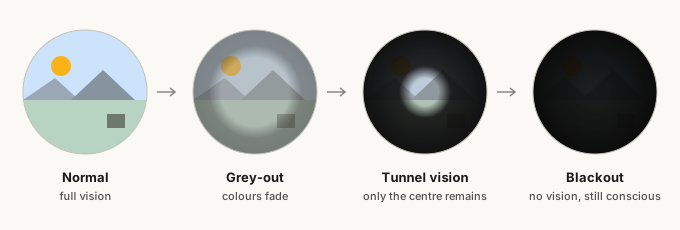
The American flight surgeon James Whinnery analysed almost a thousand such losses of consciousness in the centrifuge. According to Whinnery, tunnel vision was the last visual impression before unconsciousness and the first one after. Many pilots reported brief dream sequences with family, friends and beautiful places, along with light, floating, the sense of leaving the body, and euphoria. Whinnery himself pointed out the similarity to near-death experiences.
In 1989 the British psychologist Susan Blackmore proposed a second model that starts in the visual cortex. There, the centre of the visual field is represented by far more nerve cells than the periphery. If these cells fire chaotically, for instance because inhibitory nerve cells fail under oxygen deprivation, the result is a bright spot in the middle surrounded by darkness. Both explanations are well-founded models, but neither has been measured in a dying brain.
The last flare-up: gamma waves
That leaves the question of how a brain without circulation can experience anything at all. In 2013 neuroscientist Jimo Borjigin at the University of Michigan measured in rats that fast gamma waves increase sharply in the first 30 seconds after cardiac arrest, coordinated across the whole brain and more strongly coupled than in the waking state. Only then did the EEG go flat.
In humans there are so far only individual cases. In 2022 an international team published the EEG of an 87-year-old patient with a brain haemorrhage and epileptic seizures who died of cardiac arrest during EEG monitoring. After his heart stopped, the share of gamma waves increased, and they were tightly coupled to slower alpha waves. The authors link this pattern to the retrieval of memories.
In 2023 Borjigin's group analysed four dying patients in a coma whose ventilation was switched off. In two of them gamma activity and connectivity rose afterwards, mainly in the rear part of the cortex, a zone associated with conscious perception, and especially at the junction of the temporal, parietal and occipital lobes. This junction borders on the TPJ but is not identical to it.
Gamma waves otherwise occur during focused attention, during remembering and in experienced meditators. Whether the spikes in the dying brain actually produce an experience cannot be tested: none of the patients survived, and four cases are far too few for statistical conclusions.
The chemistry: opioids, ketamine, DMT
Besides the electrical trail there is a chemical one. In life-threatening situations the body releases stress hormones and its own opioids such as endorphins, which can dampen pain and create calm. As early as 1981 the physician Daniel Carr put forward the hypothesis that they explain the peace in near-death experiences. It has not been proven to this day.
Another approach compares what people describe. In 2019 the Liège team set 625 near-death accounts against around 15,000 reports about 165 drugs. The most similar descriptions came from ketamine, an anaesthetic that blocks the NMDA receptor for the neurotransmitter glutamate. Depending on the analysis, Salvia divinorum, whose active ingredient acts on the same receptor as the body's own dynorphins, and psychedelics such as ayahuasca, LSD and DMT also ranked high.
DMT has also been tested in the lab. In a London experiment, 13 volunteers received the substance and a placebo. Under DMT their scores on the Greyson scale rose significantly, and their experiences overlapped with real near-death experiences in most features.
A model for the whole
In 2025 an international team led by Liège neuroscientist Charlotte Martial tried to put these pieces together in Nature Reviews Neurology. The model is called NEPTUNE and starts with cardiac arrest: blood pressure drops, oxygen is missing, carbon dioxide rises, the cells' energy supply collapses, the tissue becomes acidic.
This leads to over-excitation of nerve cells, among other places at the TPJ and in the occipital lobe, and a massive release of chemical messengers. Serotonin at the 5-HT1A receptor, endorphins and GABA are thought to produce the calm, serotonin at the 5-HT2A receptor and dopamine the images, dopamine also the feeling that everything is more real than reality. Disturbed glutamate signalling, of the kind ketamine also causes, could contribute to the detachment from the body, noradrenaline, acetylcholine and glutamate to the unusually firm storage in memory.
Then there is an idea from evolution. Many animals play dead when facing deadly danger, and this freezing could share its origin with the near-death experience in humans. The authors themselves stress that the model is theoretical for now.
What the explanations don't explain
For all their plausibility, a gap remains. Each of these explanations rests on a detour: a single patient under electrodes, pilots in a centrifuge, rats, four dying patients, drug reports. An experiment that follows a near-death experience during cardiac arrest in the brain from start to finish does not exist, and it is hard to imagine one.
On top of that there are findings that disturb simple explanations. Van Lommel himself found no link with the duration of cardiac arrest or unconsciousness and noted: if oxygen deprivation were the whole explanation, most patients who had been clinically dead should report a near-death experience. It was 18 percent.
Near-death experiences also occur in people who were not in danger of dying at all. In a 1990 study, 28 of 58 people would have died without treatment, while the other 30 were never in danger but mostly believed they were. Their experiences were very similar. Only those who really were close to death more often saw a bright light and thought more clearly.
A Belgian analysis from 2014 confirmed this. 50 experiences after events without real danger to life did not differ in intensity or content from 140 after a coma. Oxygen deprivation alone therefore does not explain all near-death experiences. In a 2010 Slovenian study, resuscitated patients with a near-death experience had more carbon dioxide in their blood than the others, and the higher carbon dioxide and potassium were, the more pronounced the experience.
The memories themselves are unusual too. In a small Liège study from 2013, memories of near-death experiences contained more features than memories of real events. Van Lommel interviewed his patients again after two and after eight years: those who had had a near-death experience were less afraid of death and found more meaning in life, and this change was even more pronounced after eight years than after two.
Same brain, different stories
Finally, culture. Because the human brain is built the same everywhere, it seems natural to expect near-death experiences to look the same worldwide. The comparison shows something else, on two levels.
The first is interpretation. People who grew up in the West often recognise a figure of light as a deceased relative or a Christian figure. In an Indian study from 1986 one motif kept recurring: messengers come to take the person and send them back because of a mistake. In some accounts someone else with the same name was meant, in others the scribe of Yama, the god of death, had got it wrong.
The second level goes deeper, because the content itself varies. In 1993 sociologist Allan Kellehear concluded that the tunnel and the life review are culture-bound elements that occur mainly in societies where the major historic religions dominate. He later narrowed this down further for the tunnel: in 1994 he and colleagues found not a single one in 45 Indian accounts. In a 2009 census of non-Western accounts, no out-of-body experience appeared in the few reports from Africa and from Aboriginal Australians, and no life review in those from Hawaii, Guam and Africa.
Researchers do not fully agree on this. Susan Blackmore found three accounts with a tunnel or darkness among a small number of letters from India, and the data from non-Western cultures often consist of small collections and individual reports. Even so, they suggest that the brain supplies recurring motifs and that, at the latest when the experience is remembered and told, the images a person knows are added.
My conclusion
Near-death experiences are real in the sense that people genuinely have them and that they can be measured, counted and compared. Brain research has plausible candidates for several building blocks, even if little of it is directly proven. The direct attempt to prove perception outside the body has not produced a single recognised image in two large studies.
What remains, for me, is rather the achievement of the brain at its outermost limit. From oxygen deprivation, a last electrical flare-up and a flood of chemical messengers it builds an experience that many people describe for the rest of their lives as the clearest they have ever had.
And it uses the images it brought along.
Sources
- van Lommel P. et al., Near-death experience in survivors of cardiac arrest: a prospective study in the Netherlands, Lancet 358, 2001: PubMed
- Moody R. A., Life after Life, Mockingbird Books 1975
- Ring K., Life at Death: A Scientific Investigation of the Near-Death Experience, Coward, McCann & Geoghegan 1980
- Greyson B., The near-death experience scale: construction, reliability, and validity, J Nerv Ment Dis 171, 1983: PubMed
- Greyson B., Incidence and correlates of near-death experiences in a cardiac care unit, Gen Hosp Psychiatry 25, 2003: PubMed
- Schwaninger J. et al., A prospective analysis of near-death experiences in cardiac arrest patients, J Near-Death Stud 20, 2002: PDF
- Klemenc-Ketis Z. et al., The effect of carbon dioxide on near-death experiences in out-of-hospital cardiac arrest survivors, Crit Care 14, 2010: PMC
- Parnia S. et al., AWARE – AWAreness during REsuscitation – a prospective study, Resuscitation 85, 2014: PubMed
- Parnia S. et al., AWAreness during REsuscitation – II: a multi-center study of consciousness and awareness in cardiac arrest, Resuscitation 191, 2023: PubMed
- Elsevier, press release on AWARE II, 14 September 2023: elsevier.com
- Wikipedia: Human Consciousness Project (design and results of AWARE I)
- Greyson B., Bush N. E., Distressing near-death experiences, Psychiatry 55, 1992: PubMed
- Cassol H. et al., A systematic analysis of distressing near-death experience accounts, Memory 27, 2019: PubMed
- Bush N. E., Greyson B., Distressing near-death experiences: the basics, Mo Med 111, 2014: PMC
- Bush N. E., informal compilation from 20 studies (author's blog): dancingpastthedark.com
- Blanke O. et al., Stimulating illusory own-body perceptions, Nature 419, 2002: PubMed
- Blanke O. et al., Out-of-body experience and autoscopy of neurological origin, Brain 127, 2004: PubMed
- Whinnery J. E., Psychophysiologic correlates of unconsciousness and near-death experiences, J Near-Death Stud 15, 1997: PDF
- Eiken O. et al., Intraocular pressure and cerebral oxygenation during prolonged headward acceleration, Eur J Appl Physiol, 2017: PMC
- Cao X. S. et al., Visual symptoms and G-induced loss of consciousness in 594 Chinese Air Force aircrew, Mil Med 177, 2012: PubMed
- Blackmore S., Troscianko T., The physiology of the tunnel, J Near-Death Stud 8, 1989: Springer
- Borjigin J. et al., Surge of neurophysiological coherence and connectivity in the dying brain, PNAS 110, 2013: PMC
- Vicente R. et al., Enhanced interplay of neuronal coherence and coupling in the dying human brain, Front Aging Neurosci 14, 2022: PMC
- Xu G. et al., Surge of neurophysiological coupling and connectivity of gamma oscillations in the dying human brain, PNAS 120, 2023: PMC
- Lutz A. et al., Long-term meditators self-induce high-amplitude gamma synchrony during mental practice, PNAS 101, 2004: PubMed
- Carr D., Endorphins at the approach of death, Lancet 317, 1981: DOI
- Martial C. et al., Neurochemical models of near-death experiences: a large-scale study based on the semantic similarity of written reports, Conscious Cogn 69, 2019: PubMed
- Roth B. L. et al., Salvinorin A: a potent naturally occurring nonnitrogenous kappa opioid selective agonist, PNAS 99, 2002: PMC
- Chavkin C., James I. F., Goldstein A., Dynorphin is a specific endogenous ligand of the kappa opioid receptor, Science 215, 1982: PubMed
- Timmermann C. et al., DMT models the near-death experience, Front Psychol 9, 2018: PMC
- Martial C. et al., A neuroscientific model of near-death experiences, Nat Rev Neurol 21, 2025: PubMed
- Owens J. E., Cook E. W., Stevenson I., Features of "near-death experience" in relation to whether or not patients were near death, Lancet 336, 1990: PubMed
- Charland-Verville V. et al., Near-death experiences in non-life-threatening events and coma of different etiologies, Front Hum Neurosci 8, 2014: PMC
- Thonnard M. et al., Characteristics of near-death experiences memories as compared to real and imagined events memories, PLoS ONE 8, 2013: PMC
- Kellehear A., Culture, biology, and the near-death experience: a reappraisal, J Nerv Ment Dis 181, 1993: PubMed
- Pasricha S., Stevenson I., Near-death experiences in India: a preliminary report, J Nerv Ment Dis 174, 1986: PubMed
- Kellehear A. et al., The absence of tunnel sensations in near-death experiences from India, J Near-Death Stud 13, 1994: PDF
- Kellehear A., Census of non-Western near-death experiences to 2005: observations and critical reflections, in: Holden J. M., Greyson B., James D. (eds.), The Handbook of Near-Death Experiences, Praeger 2009
- Belanti J., Perera M., Jagadheesan K., Phenomenology of near-death experiences: a cross-cultural perspective, Transcult Psychiatry 45, 2008: PubMed
- Blackmore S., Near-death experiences in India: they have tunnels too, J Near-Death Stud 11, 1993: PDF